round the world

Back Out of the (Former) USSR

The Black Sea isn’t black.

This was not exactly a massive shock.  What was quite surprising was that a day’s bike ride in Georgia can take you from snow-capped mountains to palm-lined seaside resorts so easily.  Though it might, I suppose, be trickier in the other direction.
IMG_1485 Edit

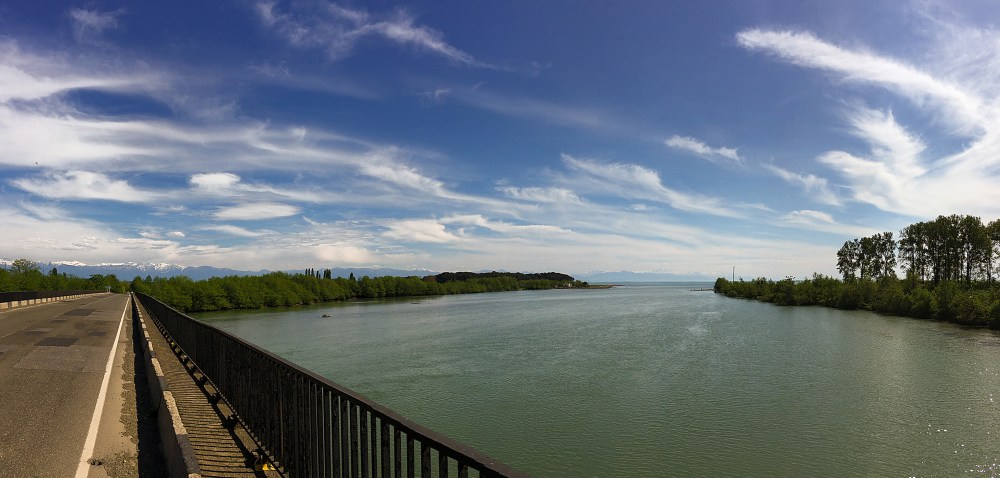
I made the most of what the weather forecast said was going to be the last day of tailwinds (on Sunday), and decided to get as close to Batumi as I could.  Before the wind decided to punish me again.  I ended up only around 30 miles short, and was rewarded by my first view of the non-black Black Sea (above).

Looks nice, doesn’t it?  Those snow-capped mountains in the background, dropping into the sea in the spring sunshine.

The short ride into Batumi on Monday was beautiful, marred only by the knowledge that it would be my last night in the country.  The last chance to stuff my face with delicious, cheap Georgian food.  And the last night for a while that I’d have a language in common with the locals.  I’m going to miss Georgia, I think.

IMG_1490 Edit

Batumi is one of Georgia’s major ports, and also a tourist resort, as well as being the last major town before the Turkish border.  The locals also seem to have developed a taste for architecture, with an impressive array of oddly-shaped towers springing up on the skyline as I approached.

The one aspect of Georgia which I won’t miss is the driving.  A bit like Thailand, they have good roads, but drivers whose skills have not caught up yet.  The massive amount of traffic cops on the roads (mostly in equally massive American police cars, for some reason) is hopefully an indicator that they’re working on it.  I had a sudden thought that I hadn’t seen a bicycle lane for thousands of miles.

A few kilometres north of the centre of Batumi, a cycle track magically appeared.  It took me all the way into town.  And then it multiplied.  The whole city is covered in bike lanes.  It was almost shocking.

IMG_1507 Edit
I had a wander around town in the afternoon, and marvelled at bike lanes zigzagging between cafes and their outside seating areas, between supermarkets and their fruit displays, and dead-ending at busy junctions.  The one above is one of the more sensible ones.  Which just stops at every road it crosses.

There doesn’t seem to be any great planning involved.  And the locals appear genuinely astonished when a bike actually uses a bike lane (which is usually for drinking coffee, walking the dog, or shopping).  But the effort is commendable.  And the major bike lanes along the seafront and the main roads are light years ahead of anything I’ve seen for months.  So, hats off to cycling city Batumi!

IMG_1511 Edit

Still, after my stroll, some seaside ice-cream, and a proper feed, it was time for bed.  And a few hours later, to cover the last ten miles of the Former Soviet section of the trip.  It’s been a great few weeks, all the way from Tashkent.  From the desert to the mountains to the seaside.  More people should come here.

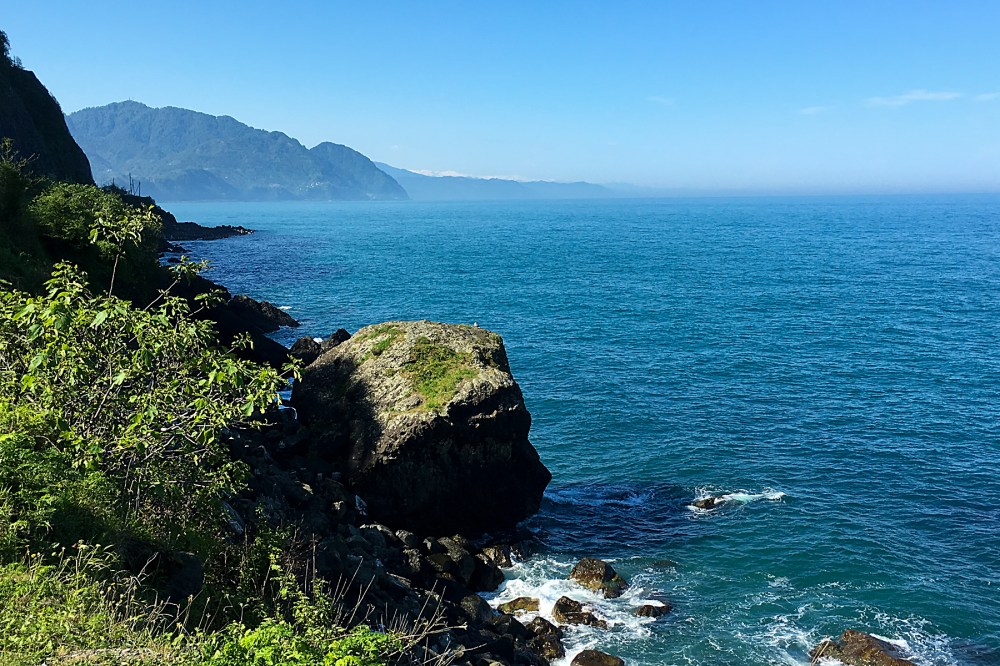
The road to the border (and after the border, for that matter) hugs the shoreline, with the impressive cliffs, and more impressive snowy mountains, dropping straight to the water.  The picture below is from the last headland in Georgia (the border is in the next bay).  So the land ahead is Turkey.  It seems a little strange that the landscape it reminds me most of is New Zealand, which is a long, long way from here.
IMG_1514 Edit

Another five minute border crossing, and I was in country number 23, heading south-west along the Black Sea coast.  A coast which takes you straight to Europe.

It’s starting to feel perilously close to the end of the trip now.  Turkey’s quite familiar to many Europeans as a package holiday destination, and the local time has ticked back to within just two hours of the UK.  It begins to feel like home is just around the corner.  Despite the beautiful scenery, the sunshine, and the wide, smooth road, I was feeling a little melancholy as I trundled along.

Then I heard a muezzin calling from a minaret, and I remembered that there’s still actually a long way to go.  Turkey’s going to take a few weeks, as it’s another big country, and then there’s the huge variety of relatively tiny European countries to look forward to before home finally beckons.  No need to worry about the end just yet.
IMG_1517 Edit

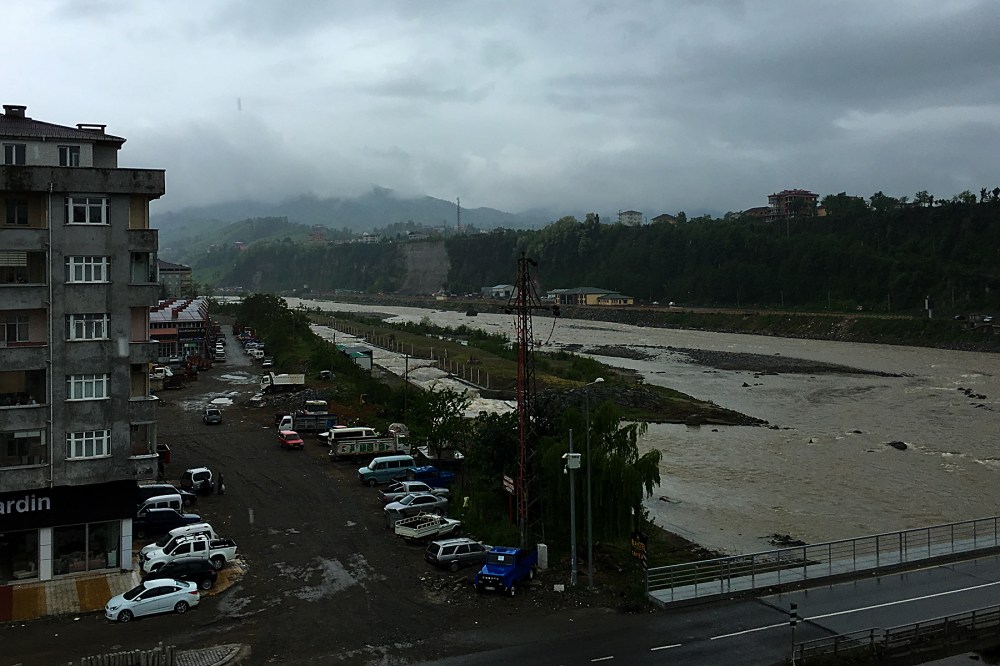
I haven’t formed much of an impression of Turkey so far.  Yesterday was just the pleasant ride from the border, and I’ve cunningly spent today having a rest while the rain hammers down outside (above).  My weather anticipation is definitely getting better.

But the people have been friendly so far, even though I’m back to having significant language barriers.  Things are more expensive than anywhere I’ve been since Vietnam.  And it’s still cold when it rains, so it’s definitely not summer here yet.

I’ll find out more over the next little while.  I’m heading straight along the coast to start with, but I’m still not sure of my exact route after the first week or so.  There are three options, all of which are more-or-less the same length (though with massively different levels of climbing).

I’ll make up my mind on the way.  The Black Sea might not be black, but it is quite big.

So there’s plenty of time to work things out as I go…

The Unbearable, The Unspeakable, The Unforgettable and the (Nearly) Undrinkable

Central Georgia.

Not top of many people’s lists of places to spend a few days on holiday.  But I think it probably should be.

20160420RTW_3 Edit
Since leaving Tbilisi (above) on Thursday morning, I’ve only covered a couple of hundred kilometres.  Pretty slack by my standards.  I even had an impromptu extra rest day yesterday.  But the last 72 hours have still felt quite intense.

Headwinds, tailwinds, sunshine, snow, climbing, descending, motorways, tunnels, falling off the bike, home-made wine and Joe Stalin’s bathtub.  Actually, perhaps it really has been quite intense…  Where do I start?

When in doubt, I sometimes resort to stats.  Not this time, though (but there will be some at the end).  This time I have photographic proof of how unbearable the weather was on Thursday afternoon:

IMG_1467 Edit

You’ll just have to imagine the painful legs and tiredness that had developed during the morning.  I knew there was a lot of rain coming, but reckoned I could beat it to Gori.  The wind (into the face, naturally) began at about 15 mph, and got stronger and stronger.  By the time the picture above was taken, it was gusting over 30 mph (50 kph).  I got slower and slower.  And then the rain came.

It was only a brief (but intense) cloudburst; a prelude to the main storm.  I hid for a while, and then put the hammer down for the last 25 kms to Gori.  When I say ‘put the hammer down’, we’re talking about maximum effort in return for less than 10 miles-an-hour.  Unbearable.

I’m sure there’s a scale for how slippery things are.  I don’t need to look it up, because if there’s one thing that’s more slippery than wet ice, it’s wet cow droppings.

An unfortunately-timed gust of wind drops your front wheel off the road and onto the gravel shoulder.  This is a problem, as it starts sliding.  And it has bags attached.  Time slows down, reactions kick in.  You get the front wheel back on the tarmac (somehow).  Then the back wheel’s on the gravel.  Sliding again.  You get your weight forward to lift the heavy back wheel onto the road, just as the front wheel hits the wet cow droppings.  Bags or not, you’re now doomed.

The only good thing about Thursday is that, having stacked the bike and smashed into the road with my right shoulder (yep, the one the truck broke in Thailand), I can now report that the bike is a tough little thing, and that my shoulder appears to be in decent condition.  Apart from the new abrasions, that is…

20160422RTW_4 Edit

Thursday night.  Looking at the weather forecast.  It says that it’s snowing in Gori.  I stick my head outside.  It is snowing in Gori.  And blowing a gale.  It says that tomorrow will be dry, but that the wind will be up to 40 mph.  Average.  In my face again.  I believe it.  I’m having a day off.

The weather forecast was spot on.  As you can see from the flag ripping itself apart on top of Gori Fortress (picture above), the wind is, indeed, a wee bit brisk.  Thankfully, as well as the castle, and a pharmacy, Gori is the home of the unspeakable Josef Stalin.  So at least there’s a museum (or dictator’s shrine, depending on your point of view) to poke around while I’m there.

IMG_1469 Edit
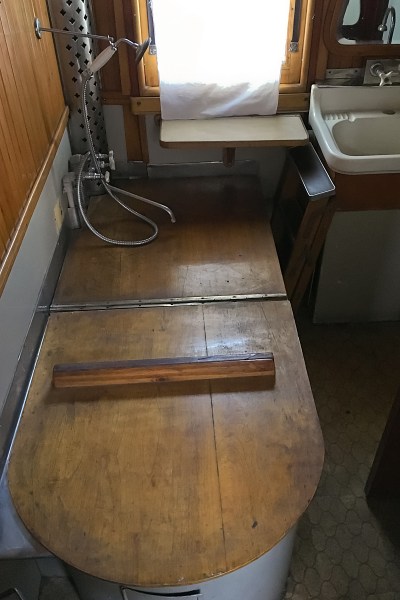
I got to see Stalin’s bathtub, on Stalin’s personal train carriage.  It’s hard to imagine Uncle Joe sitting in there, playing with his rubber ducks and smoking his pipe, while supervising the deaths of tens of millions of people.  Or industrialising the Soviet Union and winning World War 2, depending on your point of view.

The museum is pure Soviet, and could really do with a bit of updating to include some of the less positive aspects of Josef’s career.  But I guess it’s a little tricky for the Georgians.  How do you play it when the only world-famous person from your country is a character like Stalin?

Focus on the scenery and the food (and maybe the wine), I think…

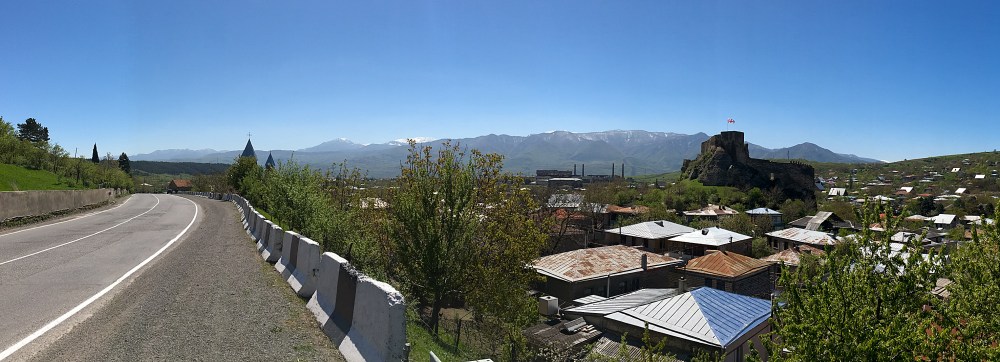
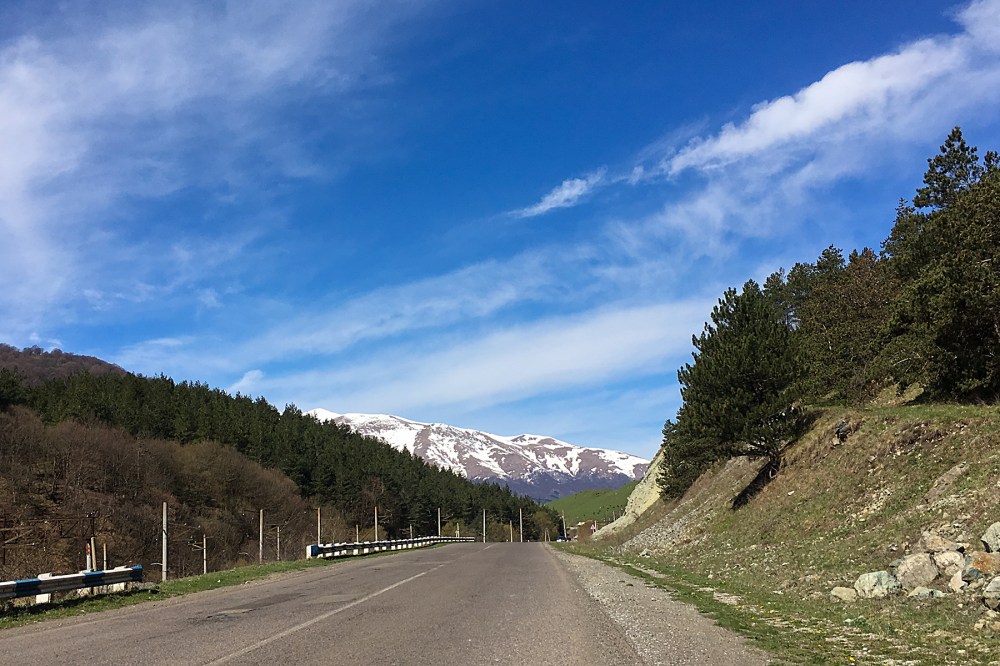
Because, once the wind had not only died, but turned magically through 180 degrees, the ride today was unforgettable.  Sun out, wind at my back, snow-capped mountains everywhere.  The little castle at Surami (below) was an especially nice bit:

IMG_1476 Edit

And I met my first fellow tourer since India.  I’ve no idea where they’ve all been.  As usual, I forgot to ask his permission to use his real name, so I’ll call him ‘Mark’.  Another Brit, and another solo inter-continental rider, heading for India via China (which is an especially long way round, in my opinion; but then he’d got to Georgia via Morocco, so what do I know?).  A great chance for the standard bike chat, with projected routes and info shared.

Both of us have been struck by the Georgian hospitality, and especially their penchant for ‘forcing’ home-made wine and vodka, some of which is outstandingly dubious, on unsuspecting guests (in my case, it was the same in Armenia, too).  ‘Mark’ was actually running with a hangover due to last night’s host insisting on ‘four for the road’ this morning.  And I had a 500ml glass of unusually yellow wine waiting for me at my lodgings this evening.

Though to get here, I still had to drop out of the high mountains, towards one of the few flat areas of Georgia, which I’ll cross in the next couple of days, before hitting the Black Sea.

IMG_1477 Edit

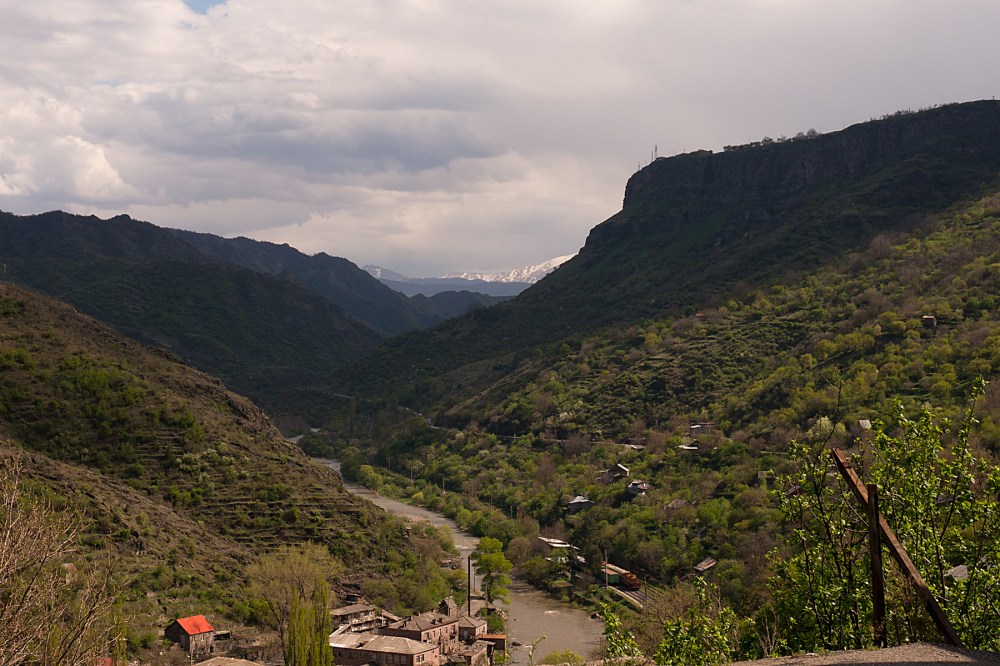
Lower hills, but the same tailwind and stunning scenery.  By the time I got here, I’d all but forgotten Thursday’s hardships.  A really beautiful run down the valley, twisting and turning in the warm sunshine.  A coffee in the shade halfway down.  Lovely.  That’s bike touring for you…

And, somewhere along the way today, I hit some large-ish numbers.  23,000 km for the round-the-world trip so far.  8000 km (and 5000 miles) since I started Part 2 in Vietnam in December.

So that’s the last three days.  A milestone or two for the trip.  Some unforgettable scenery.  The unspeakable Uncle Joe.  Sometimes unbearable weather.  And the home-made wine.

Which, it turns out, isn’t undrinkable at all…

Capital to Capital: Across Armenia to Tbilisi

This update is a little later than originally intended.  This is not due to any unfortunate mishaps, mechanical disasters, or internet access issues.

It’s simply down to nostalgia and Georgian wine.  Which is entirely unavoidable here in Tbilisi.

Hold on a minute, though.  I’ve just skipped blithely on to another country.  You thought I was in Armenia.  I’d better rewind a little…

It turns out that Armenia has three features which are hard to miss.  Firstly, it’s small.  I’ve just ridden pretty much right across it in two-and-a-half days.  Second, it’s absolutely beautiful, as you’ll hopefully agree from the pictures.  And third, it’s a little bit hilly.

20160418RTW_2 Edit

As soon as you turn north in Yerevan city centre, you start climbing.  There’s no avoiding it, whichever road you choose.  To get to Georgia, you have to cross the southern Caucasus.  You can get an idea of the climbing involved from the picture above; the TV tower poking over the near horizon is massive, and perched on a hill above the city centre.  So the city is a long way down from where this picture was shot.

You might also have noticed the giant volcano in the background.  That’s Mount Ararat (where Noah allegedly parked his ark).  The Armenians love Mount Ararat, and there are hotels, cognac, and all sorts of products named after it.  The slight downside is that, although the town of Ararat is in Armenia, the mountain is now in Turkey.  This is one of several reasons that the two countries don’t get on too well.

Regional politics were not the biggest issue on my radar on Sunday, though, as I laboured uphill out of town.  Yerevan sits at an altitude of about 1000 metres, so the air’s already a little thinner that one would like.  And the day’s ride would take me up past the huge lake at Sevan, which is another 900 metres higher.  I was gasping a little bit, I must admit.

IMG_1426 Edit

Still, the big benefit of climbing hills is that the scenery is generally a little more interesting than on flatter ground.  And Armenia is pretty stunning all the way from Yerevan to the Georgian border.  Wiggling through narrow gorges and straining over passes was a fantastic change after the flat lands of the last few months.

IMG_1434 Edit

By Monday lunchtime, I was over my second significant pass (above), and dropping in to the town of Vanadzor.  With the exception of a few minor rises around river bends, it’s about 80 kms of generally downhill road from there, all the way to Georgia.

That’s not quite as easy as it sounds, mind you.  There are a handful of scary tunnels (think pitch black with potholes and trucks), and a few rough-ish patches of road.  And Armenian dogs are the most enthusiastic bike chasers that I’ve yet had the displeasure of running away from.  But to be honest, it was a blast, essentially just dropping down one long, stunning gorge for hours.

20160418RTW_5 Edit

My last night in Armenia was where the blog update procrastination really kicked in.  I stayed at a little B&B in Alaverdi, about 40 kms from the Georgian border.  It was a really nice, family-run place, and they made their own wine.  Of course, not to try would be to offend, wouldn’t it?

A few glasses later, and writing anything was off the agenda.  And my journey to Tbilisi yesterday (Tuesday) also got off to a remarkably sluggish start.  There’s a lesson in there, somewhere…

Still, start I eventually did, and enjoyed a relaxing run down to yet another astonishingly easy-going international border.  The Armenian immigration guy had a quick chat, the Georgian just stamped my passport and waved me through.  Maybe a minute of formalities all told (plus a three or four minute ride between border posts), and I was rolling into country number 22.

IMG_1457 Edit

I was looking forward to Georgia, although I’ve never been here before.  Long, long ago, when I was in Russia as a student, I kind of fell in love with Georgian food (and also, their sweet and dangerously alcoholic red wine).  Although I’d seen an increasing amount of Georgian restaurants in Armenia, I was going to hold off until I got to Tbilisi, for the full, authentic nostalgia experience.

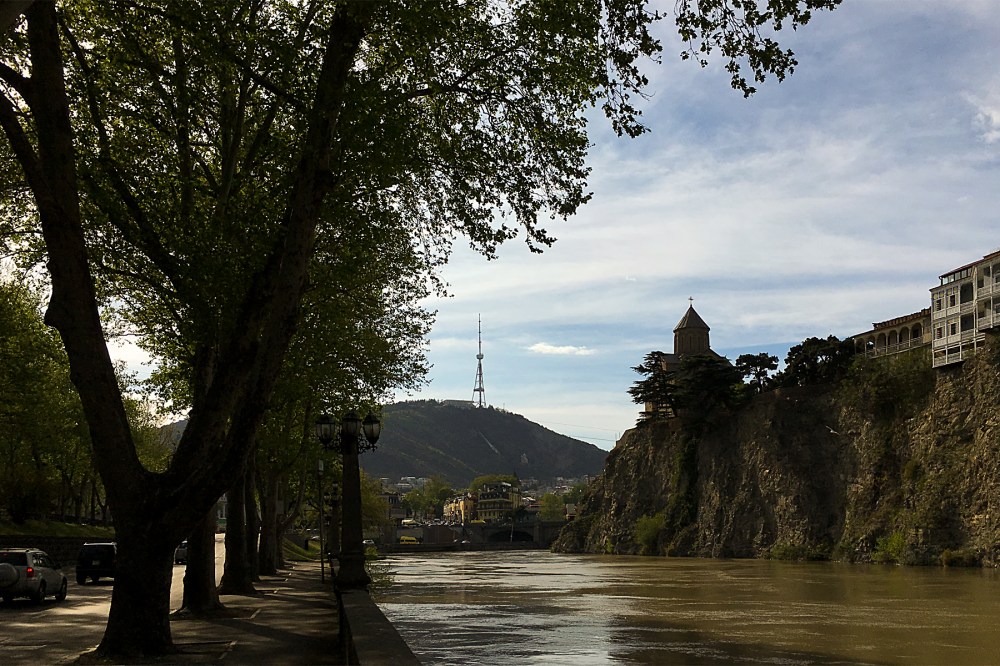
It wasn’t a hard run from the border, despite a last-minute headwind whistling down the valley as I entered town, and first impressions of the Georgian capital are really quite good.  Entering from my direction, you run along the river, with cliffs, old churches and fortresses overlooking the road.  Apart from the mildly aggressive traffic, it seemed like my expectations were going to be met in full.

IMG_1459 Edit

Having found my accommodation, I ran into an Irishman and an Australian who were about to head out for dinner (if anyone’s got any Englishman, Irishman and Australian jokes, let me know).  This, fairly predictably, meant that I consumed a colossal amount of Georgian food, topped up with the obligatory dose of red.  So a blog update was once again out of the question, and a late night round of talking rubbish was inevitable.  And quite enjoyable.

I had a sore head this morning.  Poor me.

20160420RTW_6 Edit

And so, today (Wednesday) was restricted to a slightly tentative exploration of Tbilisi.  Thankfully, I’m right in the middle of the old town here, so there wasn’t too much walking involved between either sights or strong coffee.

As with so much of the Caucasus region, there’s a lot of history here, from churches to monasteries to castles, to impressive city squares.  There’s also a cable car, which was an especially handy addition, given my fragile condition.  The views of the city from the top are really quite impressive.  Although they do remind you that the hills certainly aren’t over yet.

20160420RTW_12 Edit

My next destination here reminds you of that too.  Assuming the weather stays decent (which it may well not, unfortunately), I’ll be aiming for Gori tomorrow.  And Gori (in Russian) means ‘mountains’.  It’s also home to another side of Georgian history; it’s where a certain, less than cuddly dictator called Josef Stalin grew up.

So Georgia should continue to be interesting, with a bit of luck.  I’ll just have to try to stay off the sauce long enough to update the blog again before Turkey…

All Change

It was probably pretty clear from the last update that I wasn’t likely to be in Kazakhstan for this one.  It was time to move on from Aktau.  And from Central Asia as a whole.

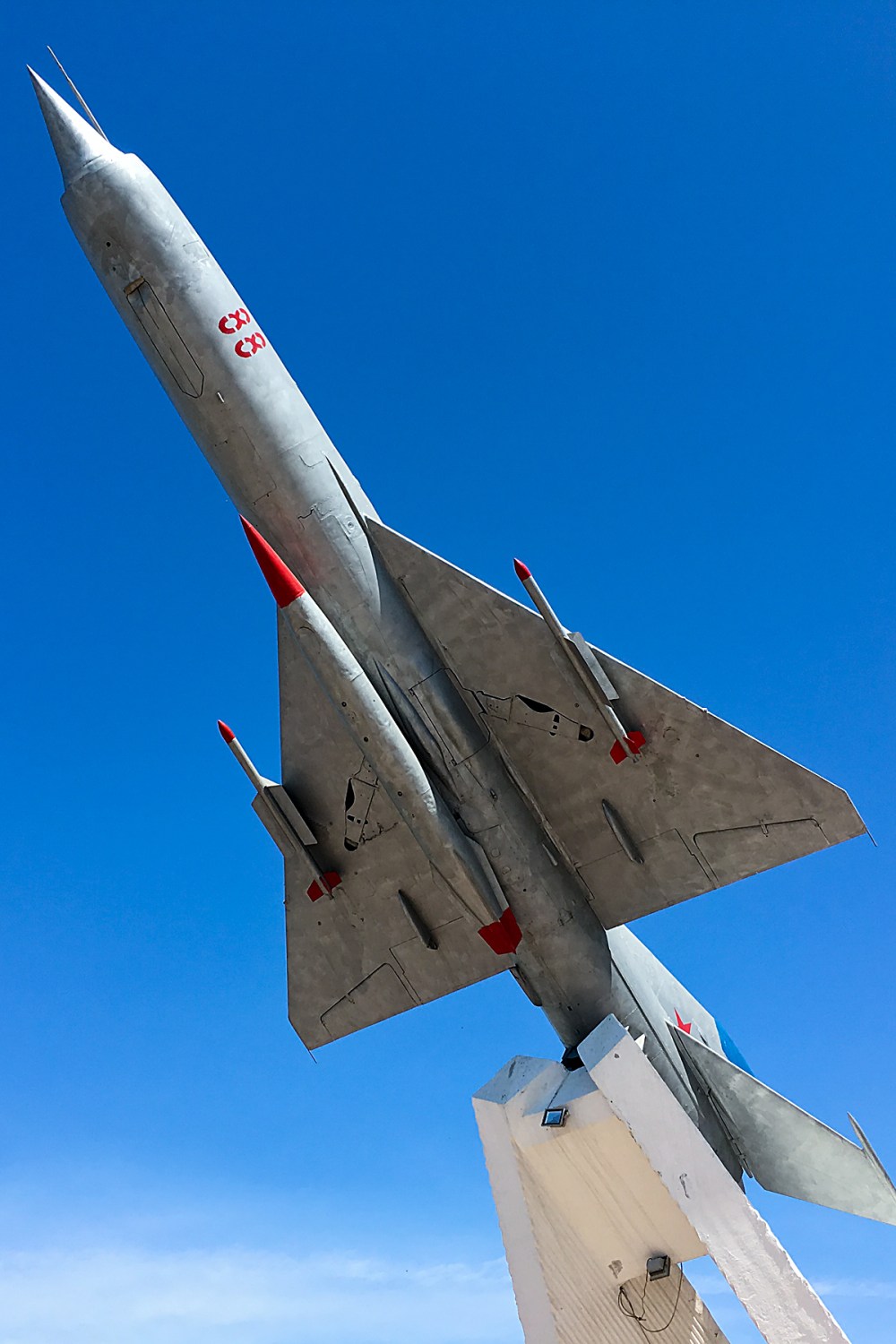
Enough deserts.  Enough camels.  And enough full-on ex-Soviet towns with planes on sticks.

IMG_1409 Edit

The last of those three may well continue to crop up, however, as I’m still in the former USSR.

The plan (once again, proving itself to be a flimsy and unreliable thing) was to follow the standard route of cycle tourists past, but in reverse.  The Beastlet and I would take a romantic voyage on a boat, across the Caspian Sea to Baku in Azerbaijan.

As a result, I had to leave the delightful panorama of Aktau, which I’d been enjoying from my room for the last couple of days (picture below).

IMG_1402 Edit

And, in the early hours of this morning (Friday), I finally arrived.

In Yerevan.  In Armenia.

I know just how sharp many of my readers are.  So it can’t have escaped your notice that this was not the city (or even the country) that I was aiming for.  It’s not like it’s far away, but it’s definitely not the same place.  So much so that Armenia and the country I intended to be in are pretty much at war at the moment.

IMG_1414 Edit

Not for the first time, though, doing things in reverse has proved to be a bit of an issue.  It was, once again, bureaucracy which caused the trouble.  This time, it was the Azeri government that was the problem.  Their foreign ministry’s website is quite excited about the fact that tourists can now get their visas online.  According to them, you just need either a ticket or a hotel reservation, put in an application, and the whole thing goes through in a few days.  Hey presto!

So, I sat down in Bukhara (Uzbekistan, for those with short memories) to apply for my Azeri eVisa.  I went to an approved travel agent’s website.  Only to discover that the foreign ministry is full of fibs.  You need to know exactly when you’re going to arrive.  You need both return tickets and a hotel reservation.  And the visa is only issued for the length of your hotel booking (i.e. you’d need to book somewhere for a week or ten days, and then cancel it after you get the visa).

If you can’t fulfil those criteria (few touring cyclists heading west would be able to: you won’t have a return ticket, and probably only a vague idea of when you’ll get there, especially as the boats don’t have a fixed schedule), you’re stuffed.  You’ll need to go to an embassy.

And, of course, by that stage, the last available embassy was already a week’s riding behind me, in Tashkent.  Grrr.  Bad Azerbaijan foreign ministry.

IMG_1416 Edit

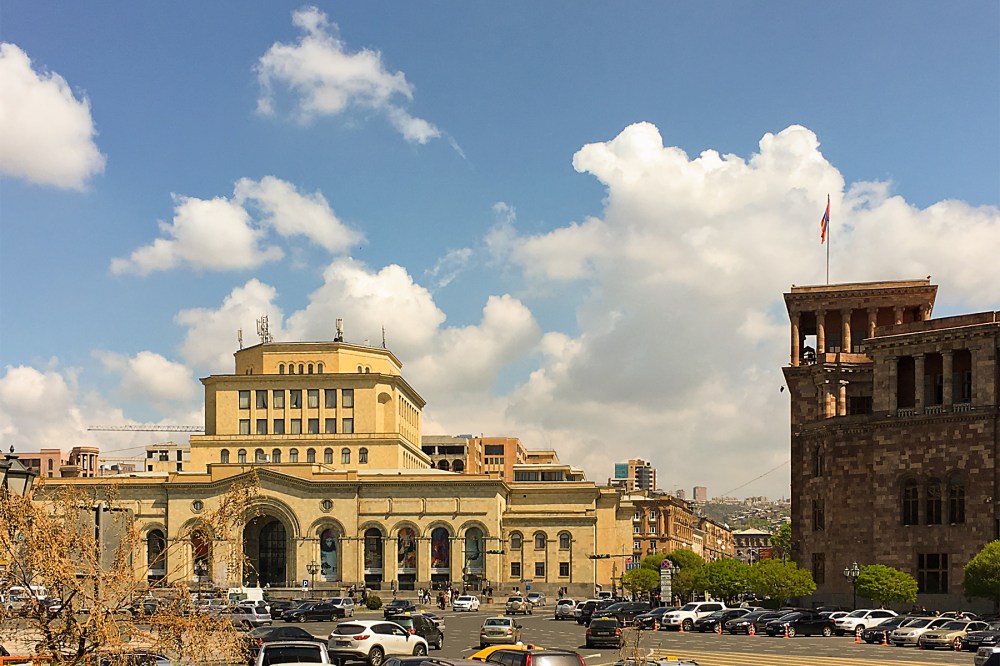
Thankfully, Aktau has a surprising variety of destinations to fly to, so it was just a case of picking the nearest place for which I didn’t need a visa.  That was Armenia, so here I am (that’s Republic Square in Yerevan, above, by the way).

Sadly, that meant that the bike, which had fondly imagined that its days of being stuffed into boxes were over, had to take one last one for the team.  I’ve solemnly promised that there are no more planes from here on.  But I don’t think it believes me.

Still, I can just mosey up the road for a few days to Tbilisi, in Georgia, and rejoin the planned route.  The little research on Armenia that I’ve done suggests it should be stunning mountain scenery most of the way up there (with some big hills to ride, too).

Which will be a big change from the flat, sandy deserts I’ve been used to for the last few weeks.  It’s basically been flat ever since I left Nepal, in fact.  So it’s time for something a bit different.

IMG_1418 Edit

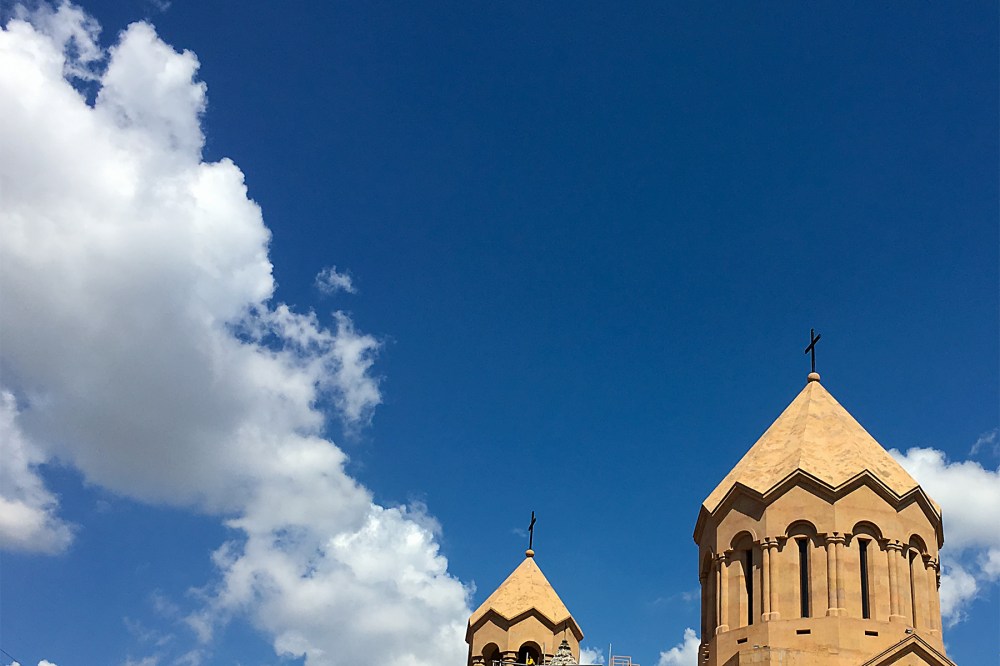
Armenia is also, apparently, the world’s oldest Christian country.  I’m not entirely sure how you prove a claim like that, but it’s definitely a very different culture from the Muslim countries I’ve just left, whereas I guess Azerbaijan would have been similar.  So another change.

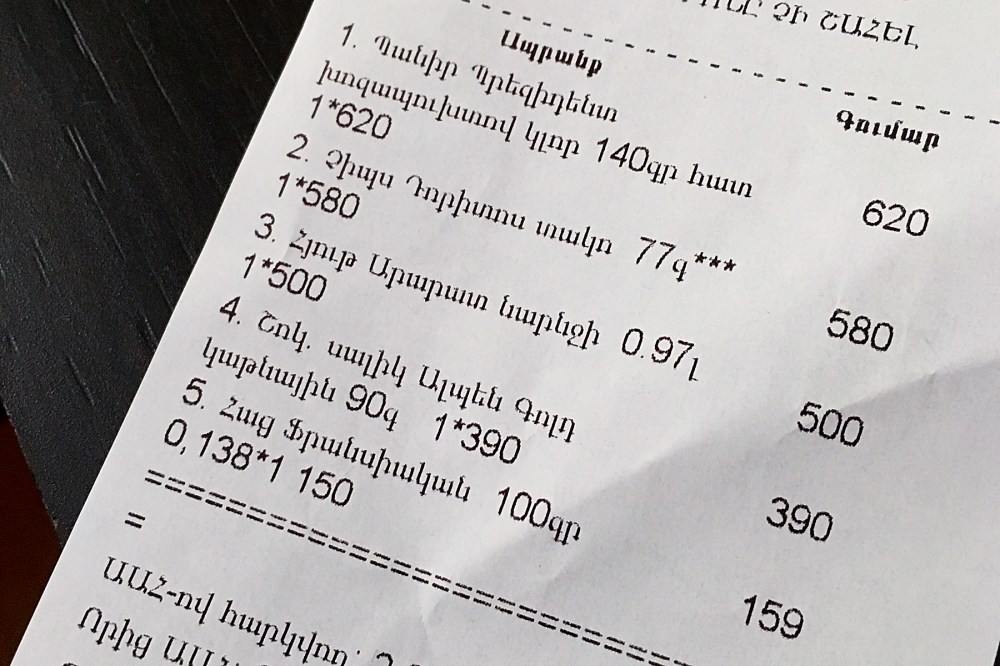
And where all the signs in Kazakhstan were written in Kazakh and Russian (both of which use the Cyrillic alphabet), most signs here are in Armenian (and English, surprisingly often).  And as you can see from the picture below, the Armenian alphabet is very definitely new to me:

IMG_1419 Edit

I’m still not sure what I bought in that shop…

Given that Uzbekistan, Kazakhstan and Armenia were all part of the USSR, it’s amazing how different they are from each other now.  Yerevan, with its broad, tree-lined avenues and street cafes feels very European in comparison to the other side of the Caspian.  It really is all change.

And, as noted last time, I may actually be in Europe already (though not by any definition of Europe that I learned in school).  Yerevan feels European, and looks quite European, too.  So maybe it is?

But I still can’t get my head around the geography.  Turkey’s border with Armenia is closed (they don’t like each other very much).  But it’s just a few miles down the road.  To the west of here, there’s nothing but Turkey for hundreds of miles.  And the whole of Turkey, surely, is in Asia, until you get to Istanbul.  So Armenia, and the Caucasus region as a whole, must be in Asia, too.  Mustn’t it?

Maybe that’s something to ponder as I’m grinding up the first serious hills I’ll have seen in months.  Maybe I’ll be able to work out the answer by the time I’m definitely back in Asia.

But maybe it doesn’t really matter.  It’s different here, for sure.  There are so many of those changes to get used to.  And that makes it interesting.

Whether it really needs a label on it, or not, I don’t know.

Sailing the Steppe (to Where the Streets Have No Name)

In the olden days (olden enough that even I wasn’t born then), ships couldn’t sail against the wind.  Captains would wait in port for a favourable breeze before putting to sea.  Otherwise they’d just get blown straight back to where they started.

I know very well that loaded touring bikes work in exactly the same way.  So I waited another day in Beyneu, enjoying the surprisingly fast internet and the nearby supermarket.  Waiting for the wind to change.

And finally, on Saturday, it was time.  The wind flipped to a more-or-less favourable direction, and I weighed anchor and set sail across 475 km of steppe towards the Caspian Sea, and Aktau.  I was going to try to hammer it in three days, before the wind decided to change again.

IMG_1356 Edit

The Beyneu to Aktau road is notorious among long-distance touring cyclists.  A few years ago, it was described as ‘the worst road in the world’ and ‘the bicycle demolition derby’.  It was mostly rough dirt (remember that track from the Uzbek border to Beyneu?) until very recently.

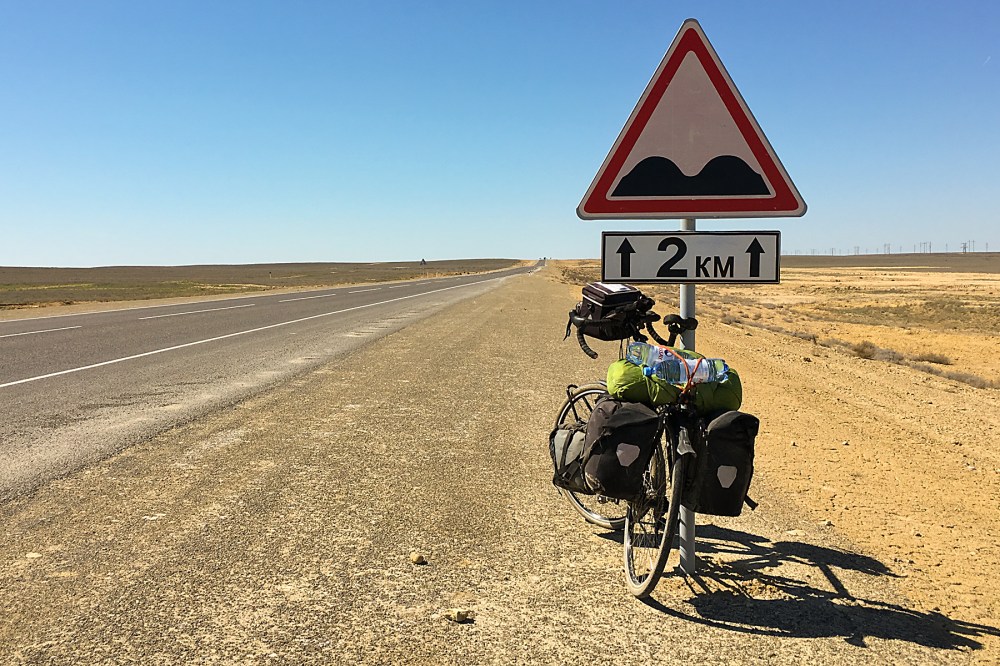
The only reason I thought I could get across so quickly was my chat with the two German cyclists I met, way back in Vietnam.  They said that the new road was only a few months off completion when they came this way last summer.  And, as you can see from the picture above, times have, indeed, changed just a little.

With the exception of a handful of kilometres, the whole run is now on decent tarmac.  And it even has informative signs.  Although, I’d be slightly concerned about why a brand new road already needs warnings about bumps…

IMG_1362 Edit

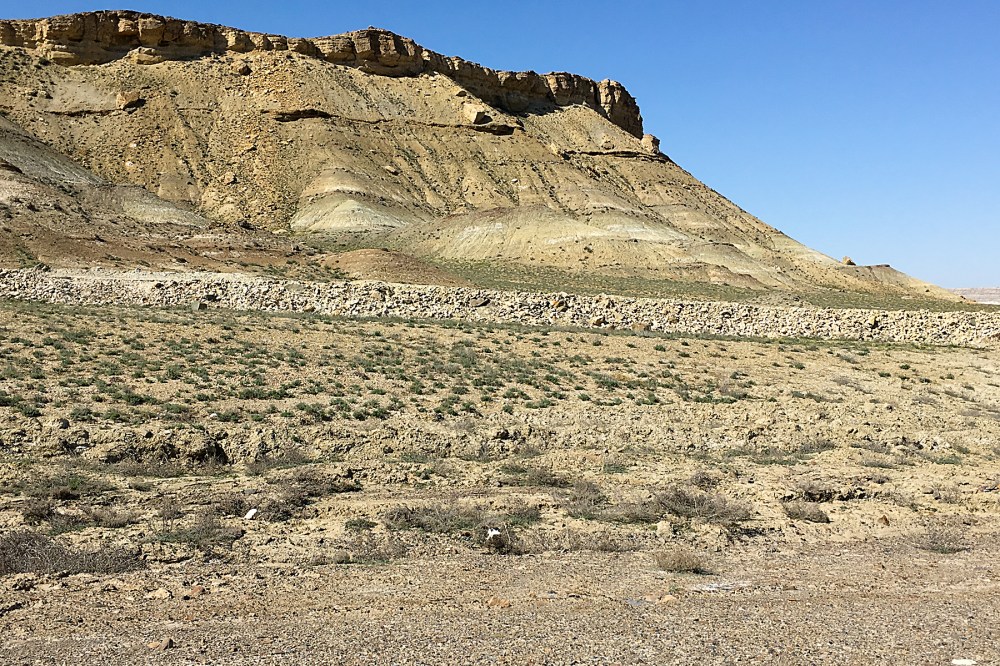
While the first couple of hundred kilometres were just as featureless as the Uzbek desert, things started to change a bit after the little town of Say Otes.  There’s a steep drop-off from the Ustyurt plateau to lower ground (you can just see the – still dirt – road down the cliff on the right of the picture above).

And the scenery suddenly looks…  Well…  Like southern Utah or Colorado in the USA.  It’s not just me, is it?  It definitely has the look of the landscape between Monument Valley and the Rockies, just in different colours.  If you’re not convinced by the picture above, try this one:

IMG_1370 Edit

Or maybe it really is just me.  In which case, put it down to desert fever…

Anyway, with the wind still favourable, the riding was good.  I started to imagine I actually was in the States, rolling along long, straight, smooth roads between the Mesas.  This was only contradicted by the occasional disapproving camel, which I studiously ignored.  The wind actually got stronger, and at some points, I was being pushed uphill without pedalling.  Just the power of the wind on the bags / sails.  Fantastic.  This three day thing was going to be, erm, a breeze.

By the end of day two (Sunday), I was already 335 km (210 miles) down the road from Beyneu.  One more long-ish day to go; maybe 90 miles.  The wind would be mostly behind for the first stretch, pretty much across me for the second part, and a cross-head wind for the last forty-odd kms.  But I’d nearly be in Aktau by then.  It wouldn’t be a problem to gut through that.  I went to bed a very happy boy.

Then Monday happened.  These deserts really do have a habit of kicking you in the backside if you get ideas above your station.

The first stretch went much as planned.  Wind in my sails again, I whistled along effortlessly at over 30 kph to the junction at Tauchik, where I turned onto stage two of day three.

Then I got blown off the road.  Twice in five minutes.

Quite literally, blown off the road.

It’s no wonder I was ripping along that first stretch; the wind was gusting over 40 mph.  And now, it was being funnelled through the hills, so I never knew exactly where it was coming from next.  The only thing that was clear was that it was further round than it should have been, and pretty much stopping me in my tracks.

One minute, I was in my lowest climbing gears, struggling to make walking pace as the wind battered me head-on.  The next, I was leaning over at twenty degrees to keep the bike upright, as the wind made a concerted effort to push me off into a herd of those disapproving (and by now, slightly alarmed) camels.

Those sails of mine are really not great when the wind’s not playing ball.  But at least the scenery was still impressive:

IMG_1377 Edit

By the time I’d made it a few more kilometres down the road, though, even the landscape wasn’t keeping me happy.  My quads were fried from fighting to move forward.  My back was fried from trying to stay upright.  Even my ears were getting wind-burned.

And, maybe more importantly, I realised that this was actually quite dangerous.  If you’re leaning over against the wind, and the wind suddenly stops, you swerve uncontrollably into the middle of the road.  This is dodgy enough if it’s just the wind gusting and then easing.

If the wind happens to have been blocked by a passing truck, it has very alarming consequences.  Impressive though the wheel-nuts on articulated trucks are, I’d rather not be looking at them from a couple of feet away while swerving towards them in goggle-eyed panic.

After a few more near-misses with lorry wheels, I pulled over to rest and consider my position.  Maybe those sea captains of old had cunning ruses in hand for when they suddenly found they were being blown way off course.  Maybe.  But I didn’t.  At the pace I was going, I’d die of old age before I finished the last 50 miles to town.  If the trucks or the camels didn’t get me first.

For a moment, I was actually considering walking it (over two days, probably).  Thankfully, that particular line of stupidity was cut off by the arrival of Rustam in his shiny 4×4.

IMG_1383 Edit

Although he spent a bit of time mocking my idea of a windy day (apparently, you can get sandstorms out here which last for days when it’s having a proper blow), Rustam turned out to be an absolute gentleman.  Bundles of insulation in the back of the car were moved.  Seats were dropped down, the bike was loaded.

And, and hour or so later, I was in Aktau with my rescuer, who also insisted on buying the coffee.  I may not quite have sailed all the way from Beyneu under my own steam (so to speak), but this was a far better ending than I was contemplating by the roadside a short time before.  Thank you, Rustam!

And so, I found myself on the shores of the Caspian Sea.  In Aktau, where the streets have no name.  They really don’t.  I was vaguely aware of this from researching the region before I started riding.  I doubt if Bono and U2 had Aktau in mind when they wrote the song, though…

The city is divided into ‘micro-rayons’, which are essentially large city blocks.  The micro-rayons are all numbered.  Roughly speaking, the micro-rayons change at every major junction.  And, again roughly speaking, the numbers increase the further from the centre you are.  Your address here is just three numbers: micro-rayon number, building number, and apartment number.  That’s it.  It completely does my head in.

IMG_1394 Edit

It may also be the most interesting thing about Aktau, from a tourist’s point of view.  It’s a port town, so it’s pretty functional, rather than fascinating.  But it’s good to have the benefits of civilisation (beer, pizza, cash machines etc) again after the desert.  And there are Soviet war memorials, statues, parks and shops.  It’s getting wealthy, too, from oil, as is a lot of this part of the world.

And I’ve managed to get a ticket sorted out for the next stage already.

Depending on how you define it, it’s Europe on the other side of the Caspian.  The Russians see the sea as the dividing line between Europe and Asia, together with the Ural mountains further north.  As a western European, I’m struggling to think that a region which is east of Turkey (which is clearly mostly in Asia) can really be in Europe.

After all, I can’t be that close to home already, can I?  Anyway, more on that next time…

For Touring Cyclists:

I’ve put together a PDF guide to the Aktau to Beyneu road, as it was quite difficult to find anything current (after 2013), and the road has changed so much in the recent past.  The PDF has GPS distances, water and food points, road conditions etc.  Beyneu to Aktau – April 2016.  Or feel free to contact me, and I’ll be happy to discuss.

The Full Soviet

I had to tear myself away from Khiva in the end.

I allowed the lady who ran the guest house to persuade me that I should stay one more day.  She’d read the tea leaves, or something, and was convinced that if I left on Wednesday, I’d just get soaked again, and probably freeze to death.  It would be much better to leave on Thursday.

Plus, she’d get an extra day’s money, of course…

I’d checked the more scientific weather forecast, and, while it didn’t suggest much rain at all, another day in Khiva felt like a good idea (I’m not sure I’d fully recovered from that marathon 200-plus kms a few days before).

IMG_1294 Edit.jpg

So I stayed.  I had another poke around the old town, sampled some more coffee and kebabs in various hostelries, and gave the bike a good clean, which it much appreciated.

Needless to say, it was sunny all day.  And when I awoke to get moving northwards on Thursday, I was greeted with a heavy shower, black clouds, and gusty winds that would be at least half in my face all day.

Oh, good.

Still, if I’d stayed in Khiva any longer, I’d have started growing roots.  So I resigned myself to a longish, slowish slog for a couple of days.  I donned the cold weather gear and the rain jacket again, and set sail for the last chunk of Uzbekistan that stood between me and  the border; Karakalpakstan.

IMG_1299 Edit

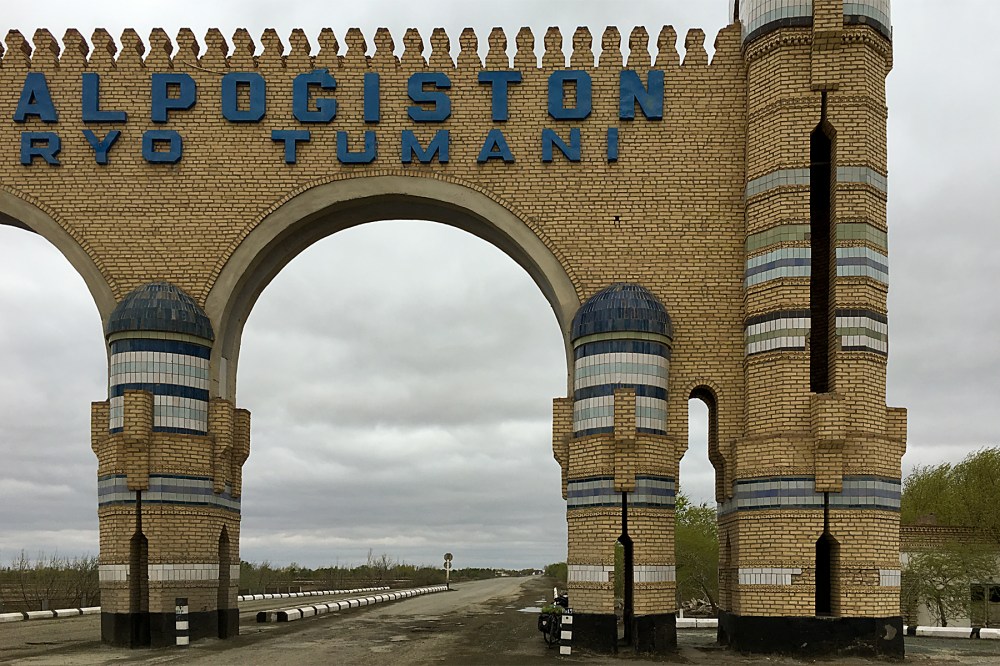
Or ‘Karakalpakistan’, as people took to calling it the closer I’ve got to it.  By the time I crossed the (frankly over-ornamented) border, above, the spelling had shifted all the way to ‘Qaraqalpogiston’.  It’s no wonder that it’s a bit tricky to search for stuff on the internet over here; there are usually at least two possible spellings in Latin script, plus at least one Cyrillic version.  It’s amazing you can ever find anything…

My target was Nukus (or ‘Nokis’, etc, etc), which is the capital of Karakalpakstan / Qaraqalpogiston.  It was only about 180 km up the road from Khiva / Xiva, but it felt like an awful lot further.

Thursday was essentially spent trying to outrun showers, while dodging potholes.  And averaging a colossal 15 kph into the teeth of the wind.  Urgh!  Progress was not really helped by the awareness that, after Khiva, I was out of charming Silk Road cities to explore.  And that all I was really doing was positioning myself for hundreds of kilometres of desert.

Given the lack of ancient historical sights, I thought I’d better concentrate on the more prosaic and everyday aspects of life in a post-Soviet republic.

Thankfully, Karakalpakstan is just the place to do this.  Which made the second day to Nukus (Friday) much more bearable.  I crossed a fantastically flimsy, improvised pontoon bridge, made it back to the main road, and took a left towards Kazakhstan.

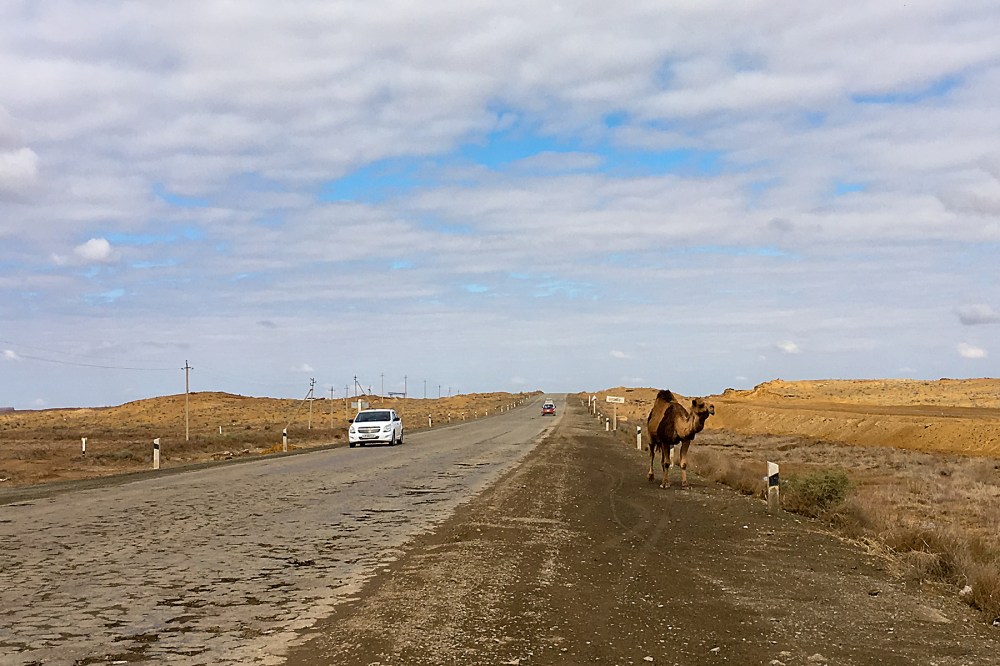
The beautiful new road has not made it this far north yet, and you can see the consequences below; the old road (quite chewed up), the shoulder (dirt, but smoother than the road), and the unfinished new road (behind the camel).

IMG_1312 Edit

Oh yeah, the camel.

This was something new.  Although I’ve had my path obstructed by a number of beasts in the past, this was my first wild camel.  But they’re apparently quite common further up the road.  I’ll try to get a closer picture next time; this guy actually strolled right up to me, but I’d put the phone away by then, in case I needed to make a run for it.

Turned out he was much more interested in the bins at the nearby petrol station than in me, so I’ll try to be a little braver next time.

The camel is a fairly normal sight over here, but not something I’d usually expect to see.  Nukus, on the other hand, is a straight copy from the template of small, ex-Soviet cities.  It’s pretty easy to find Nukus clone-towns from the Sea of Japan to the Polish border.

Naturally, I’m once again staying in the most Soviet place I could find:

IMG_1321 Edit

And this hotel may actually not have changed at all in the last 25 years.  Certainly, the plumbing and electrics (as well as the carpet) are of that sort of vintage.

The town itself is a mixture of grandiose public buildings, large concrete blocks of flats, and dirt streets lined with small shops.  All carefully planned, and sensibly placed.  After all the beautiful mosques and minarets of the Silk Road cities, it’s a little bit of a come-down.

IMG_1323 Edit

On the other hand, it’s the last city I’ll see for quite a few days (if all goes according to plan), so it’s nice to be able to stock up at the supermarket, get a decent cuppa, and wander the broad, carefully-swept boulevards.

Soviet-style or not, I have a feeling I’m going to miss the benefits of civilisation as I head back into the desert again…

50 Shades of Beige

Plans are strange things.

I’ve often been asked why I’m riding around the world on a bike.  I find it hard to answer.  I tell people that I’ve always liked bikes, and I’ve always liked travelling.  So putting the two together was obvious.  This is all true.  But I can’t pinpoint when it became obvious, or why.  I can’t tell people when the idea was born, or when it became a plan.

But at some point, it did.  And then the vague plan became a more detailed plan (though still outstandingly vague by most people’s standards).  And then the plan started to happen.  And now, here I am, bouncing around on a bike in Uzbekistan.

IMG_1270 Edit

Leaving Bukhara on Saturday, another plan was mysteriously germinating.  My conscious mind was preparing for a four-day ride across the Kyzyl Kum desert to the oasis city of Khiva.  I didn’t realise that my subconscious, having noticed the weather forecast, had already decided to do 450-odd kilometres (marginally under 300 miles) in three days.

Kyzyl Kum translates as ‘Red Desert’, and it’s the fourth-biggest desert in Asia, covering a massive swathe of Uzbekistan and neighbouring Turkmenistan.  But as you can see from the picture above, the rickety road out of Bukhara took me not into redness, but into a sea of beige.

The plan worked, as far as day one was concerned.  Just over 100km to Gazli, wafted along by a gentle tailwind (as my subconscious noted).  And the road improved all the way there, even turning into super-smooth concrete about 10 km before town (my subconscious noted, again).  Shower, kebabs and bed at a truck stop.  All very much according to plan.

IMG_1273 Edit

I still hadn’t worked out what my subconscious was up to when I woke up early on Sunday to discover that the south-easterly breeze had strengthened.  That’s a strengthening tailwind.  How interesting.  Eventually, after two cups of coffee, I started to put things together.  If the brand new road remained the same…  If the wind stayed put…  Maybe…

The wind stayed (at least until the last hour of the day).  And the road actually got better, turning into a perfectly smooth, almost completely deserted, dual carriageway, which might, for all I know, go all the way to Kazakhstan.  It certainly runs all the way until I got off it at the end of the desert.  So I got my head down and kept going.  There was nothing to see, anyway, and everything remained beige (picture above).  I stopped for a drink, and realised I’d been zipping along at 30 kph.

Lunchtime.  It may not be red, but the desert certainly is monotonous.  Concrete, sand, scrub.  Beige.  And 100km down.  Feeling fresh.  And finally, the thought lodged in my head properly: I might actually be able to hit 200 km for the day.  Which would be almost the end of the desert, and within one more day of Khiva.  Head down, push on.  Let’s see what happens.

This is what happened:

IMG_1276 Edit
That’s a record.  For me at least.  I’ve not been near 200 km before in a day (and quite possibly won’t be again), so I was reasonably chuffed with myself.  213 km.  132 miles.  And a friendly little teahouse at the end of it (or, more accurately, in the middle of nowhere), which was only too happy to let me stay, for a small fee.  Kebabs, bread, bed.  What a good day.

IMG_1278 Edit

It couldn’t last, of course.  The weather forecast in Bukhara had said there was rain on the way, which is one of the reasons my subconscious had decided to put the pedal(s) to the metal.  My pleasure at waking up to a view over the Amu Darya river to Turkmenistan was marred by two things: it was already drizzling, and Turkmenistan appears to be just as beige as Uzbekistan.

It doesn’t seem fair when it rains in the desert.  It certainly doesn’t seem fair when that rain continues for nearly the whole day.  Yesterday (Monday) was ugly.  Already wet and cold as I reached the end of the desert, I swung off the beautiful main road, onto the shortest way to Khiva.

Big mistake.

Potholes, washed-out roads, landslips, sand, mud.  The whole gamut of road problems.  Much grinding of drivetrain, much splashing of beige dirt onto previously non-beige shoes.  Wet feet.  Oh, and the most aggressive pack of feral dogs I’ve yet had the displeasure to meet (many thanks to the three locals who positioned their cars between the beasts and me, so I could make my escape!).

Still, cycle touring’s nothing without a little rough to make you appreciate the smooth.  And eventually, after a signposting error (i.e. there wasn’t one – a standard Uzbek problem) had cost me an extra ten miles, I finally ground and scraped my way into the ancient city of Khiva.

20160329RTW_27 Edit

Which was…  Guess what?  Beige.

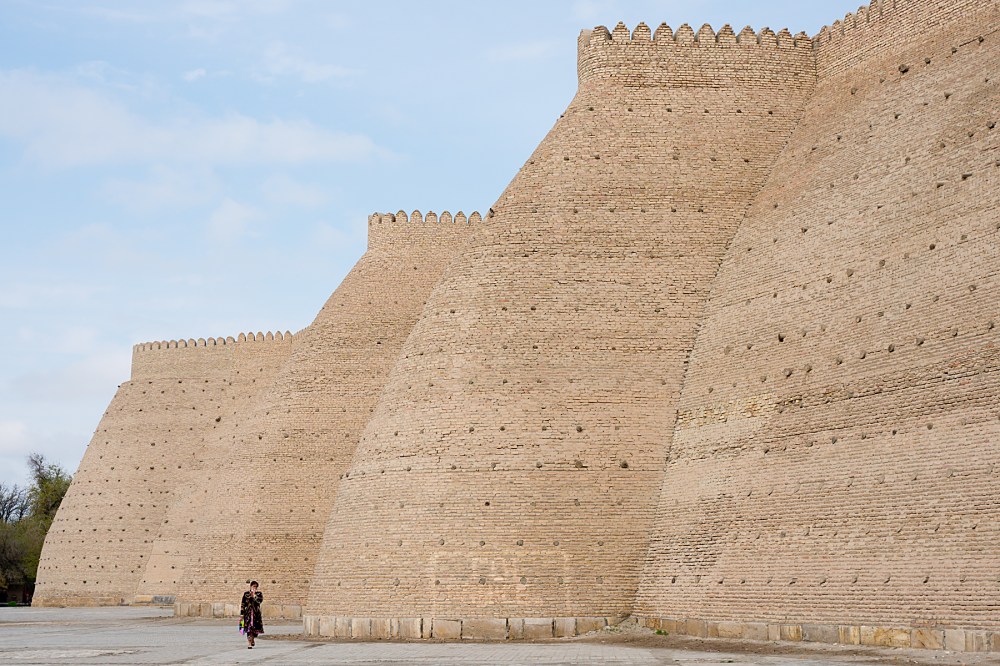
Not entirely surprising, as the old city is surrounded by impressive walls made of local mud.  Hence the colour.  And, having recovered from the beigeness of the place, I think it’s probably my favourite of the three old trading cities I’ve seen in Uzbekistan.

Khiva’s much smaller than Bukhara, which in turn is smaller than Samarkand.  And Khiva’s old town is pedestrianised, meaning that you can just meander through the ancient alleyways and bazaars.

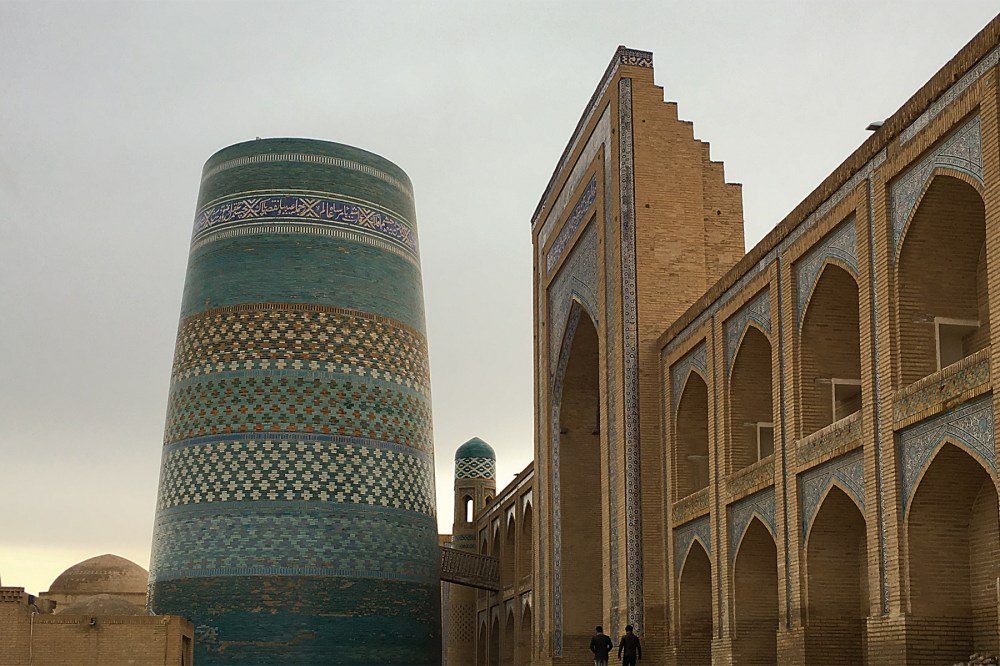
And there is even the odd splash of colour (like the famous unfinished minaret, below):

20160329RTW_45 Edit

I’ve had a rainy day off here today, but the plan (assuming the weather plays ball) is to get back on the road tomorrow, through the last of the irrigated areas of Uzbekistan, towards an even larger stretch of desert, and, eventually, Kazakhstan.

At least, that’s the plan as far as I know it.

If you’re still having doubts about plans being strange and unpredictable, by the way, consider this.  After eventually deciding to go, and with a little bit of a plan, I set off on my bike around the world.  I rode for a long way.  And I’m still riding.  Stuff has happened, plans have changed (whatever happened to South America?).  But I’m still rolling.

Today is the 29th March 2016, and in terms of days spent cycling around the world, today is day number 365.  Exactly a year spent on the round-the-world ride.

Of course, it’s a lot more than a year since I started.  The plan was a little disrupted by getting hit by the truck in Thailand.  And when did that happen?  The 29th of March.  Exactly a year ago…

Pretty sure I couldn’t have planned it like that…
For Touring Cyclists:  
If you’re coming this way on a bike, be sure to check out the Pedalling Prescotts excellent guide to this section of Uzbekistan.  They rode the other way (from Khiva) in early 2015, and their info is by far the most complete I’ve seen.  
Apart from the main road having improved (it’s still being built, so should continue to), a couple of police checkpoints having moved, and a couple of new chaikhanas having opened (so more accommodation options), their guide is pinpoint accurate in terms of where stuff is, and what’s there.  Including the hotel on the edge of the desert which no locals have ever heard of.  Oh, and where they say that the small road to / from the A380 deteriorates a bit, take that to mean ‘descends into hell’.
If you want my full list of places and mileages (from March 2016), I’ve put together a PDF sheet:  Bukara to Khiva March 2016.  Or give me a shout via the Contact page to discuss.

The Four Horsemen and the Oasis

It’s been an odd few days.

For the last two, I’ve been loafing around in Uzbekistan’s second famous Silk Road city, Bukhara.  It’s a beautiful city, and an interesting place to be:

IMG_1261 Edit

On the other hand, getting here was something of an ordeal.

After a nice, easy cruise away from Samarkand on Tuesday, all four of the Horsemen of the Cycling Apocalypse made an appearance on Wednesday at the same time.  This is not a usual thing.

Normally, I get to moan about either the headwind or the road surface.  This is surely infinitely boring to anyone who’s not me.  I know that, and I’m trying to keep it to a minimum.

But getting all four of my personal worst cycling problems at once (that’s a strong headwind, plus an awful road surface, plus driving rain, plus cold) is just nasty.  And it made me look like this, with half of a long, 140 km plus, day still to go:

IMG_1231 Edit

That’s my grumpy and self-pitying face, by the way, in case you didn’t pick it up.

I can already hear my Northern English cycling colleagues telling me not to be such a soft Southerner.  Grab a quick cup of tea, and get back on it.  You can only get wet once.  Hard day?  There aren’t even any hills!

Yep, they’re annoying, aren’t they?  Especially as they’re just voices in my head at the moment.  But they’re also right.  It wasn’t the apocalypse, just a longish, hardish day on the bike.

IMG_1237 Edit

In any case, as I ground my way towards Bukhara on the damp gravel shoulder (it was much smoother than the road), I had other things to ponder to take my mind off my own worries.

I was surprised that the first question I got when I found a roadside hotel on Tuesday evening was ‘Are you Belgian?’.  The manager launched straight into a quick summary of the then-developing situation in Brussels: another grim act of pointless violence by some lunatic religious fundamentalists.

Ironically enough, as well as being a major trade centre and oasis, Bukhara (along with Baghdad) was one of the great seats of Muslim learning in the middle ages.  When the Muslim world held on to humanity’s stock of knowledge while some lunatic religious fundamentalists in Europe were busy killing each other, and forgetting how to make toilets for hundreds of years.

20160324RTW_27 Edit

The sad thing is, that I could see the hotel manager looking at me while he was telling me about Brussels.  I think he wanted to see if I’d somehow blame him, as a Muslim, for the attack.  I guess, if I’d never met a Muslim before, or if I was Donald Trump, I might have done.

I suppose it comes down to perspective.  My slightly tricky ride on Wednesday wasn’t really the apocalypse.  And the horrible attack on Brussels is utterly at odds with how warm, friendly and welcoming Muslims have been to me and my bike, whether in Uzbekistan, Malaysia, India or Indonesia.

You can’t let a few cycling irritations get in the way of a round-the-world bike ride.  And you can’t let a few loons colour your view of an entire culture.

Bukhara is well worth a look, by the way, if you’re ever travelling in this direction.  It’s much more compact than Samarkand, and you can wander around the old town on foot very comfortably.

20160324RTW_28 Edit

I’m still not sure whether the Soviet approach of restoring ancient buildings (rather than just preserving the ruins, as we would at home) is the most authentic way to go, but it certainly makes it easy to imagine strolling around the bazaars, fortifications and mosques hundreds of years ago.  And as the original buildings were badly damaged by the Red Army in 1920, I guess they owed it a refurb.

In any case, my time at the oasis is nearly over.  Tomorrow, I’ll be out of the irrigated zone, and off into the desert for the first of two long stretches.  It’ll probably be a few days before I get back to an internet connection.

And, given the almost total lack of facilities en route (it really is a proper desert), I may even have something reasonable to moan about next time…

On Ancient Roads

I was pretty tired by the time I got into Samarkand last night (Sunday).

Well over 300 kilometres from Tashkent in three days, through rain, over hills, and into headwinds.  It was fairly hard on the bike.

I’m not sure I’d want to try it on a camel.  Or on foot.  I’ve been on some very long, straight roads, which left me plenty of time to imagine travelling this route seven or eight hundred years ago.

But people really did travel this route on their camels and their feet for hundreds (maybe thousands) of years, bringing silk and spices from the far-away Orient to the edge of Europe.  And they left some quite impressive monuments behind them.

This is right next-door to my guesthouse here:

20160321RTW_7 Edit

Which is undoubtedly a good landmark to finish the first section of the Silk Road.

But it didn’t start well on Friday.  After all the rain during my stay in Tashkent, the Internet said that Friday was going to be overcast and cold.  But dry.  And it was all those things as I started off.

Two hours later, I was clear of town, and well on my way to the middle of nowhere, when the rain began.  It didn’t stop all day.  And so, my first day riding in Uzbekistan degenerated into a sorry, soggy, shivering mess:

IMG_1195 Edit

Thankfully (and partly due to gracefully declining the first of two wedding invitations I’ve had on the road already), I made it to Gulistan just before hypothermia set in.

I knew there were a couple of hotels there, but I couldn’t find them (the signposting here is generally awful).  In the end, I asked a policeman.  Although this is generally accepted behaviour at home, the general word on cops in former Soviet countries is to leave them well alone.  But I didn’t have a choice.  I needed to get inside, and quickly.

Either because of my pathetic state, or because he was just a nice bloke, I ended up following a police car through the streets for the last two kilometres of the day.  The third hotel we went to had space, and I was absurdly grateful to get under a hot shower, knock back a steaming pot of tea, and collapse onto a sofa for a while.

I was also quite relieved that the rain drifted off towards the mountains during the night, and hasn’t been back since.

IMG_1209 Edit

What with the random wedding invitations and helpful policemen, Uzbekistan’s character is starting to reveal itself.  Friendliness definitely seems to be a strong trait.  Including hugs from total strangers.  It’s definitely got the former Soviet feel.  I get especially strong flashbacks from people with vodka on their breath before lunchtime, and gold teeth.  Though huge wall murals like the one above are also good reminders, albeit with no hammers or sickles any more.

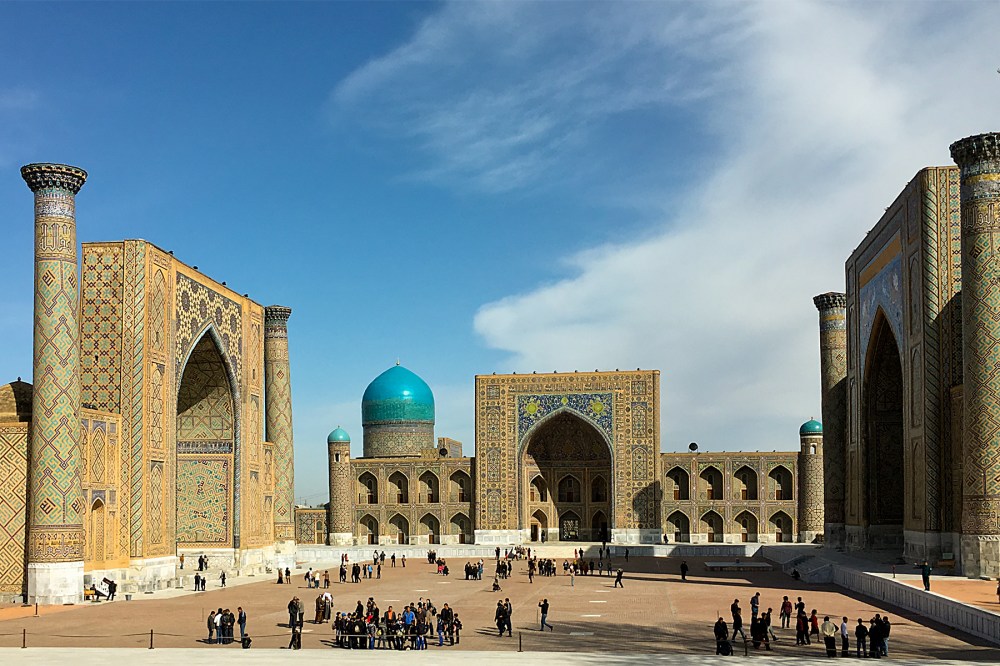
But as the Registon in Samarkand (below) and the many other bits of spectacular Islamic architecture remind you, this is also a country with a strong Muslim culture.

IMG_1210 Edit

And I think it’s probably the Muslim tradition of hospitality that’s leading to the invitations and general helpfulness that I’ve encountered so far here.  It’s really nice, although there is the slight drawback of ending up in a twenty minute conversation every time I stop by the roadside.  Which is definitely slowing my average speed a little.

And it’s also Navro’z (Uzbek spelling, there are many variations) at the moment, which means that Samarkand today was like a ghost town as everyone (including the restaurant owners and shopkeepers) had a day off.

20160321RTW_17 EDit

Still, it’s definitely so far, so good in Uzbekistan.  The roads are reasonable (mostly).  The driving, which is often slated by those coming on bikes from Europe, is so much better than in India that it seems really, really good.  And yet again, people (as they seem to be almost everywhere) are being marvellous.

Back on the road tomorrow for another near-300 kilometres towards Bukhara, the second of the major Silk Road cities.  That should be another three days.  Assuming I can restrain myself from joining in the three-country, vodka-fuelled political debate that’s going on in the guesthouse courtyard at the moment.  I’m tempted.  But I’m just not convinced that strong alcohol is necessarily the best preparation for more long days on the Silk Road…

Back in the (Former) USSR

I’ve been off the bike for a whole week.

I’m feeling a little bit chubby, and a little bit lazy.  Especially lazy, as I watch from my warm room as yet another band of cold rain strafes Tashkent.

It’s been worth the time off, I think.  A few days to recharge, and to ready myself for a lot of long, hard miles to come.  And a little time to adjust to the cultural and meteorological differences between India and Uzbekistan makes the change less stressful.

And it really is a different world on this side of the Hindu Kush.

IMG_1175 Edit

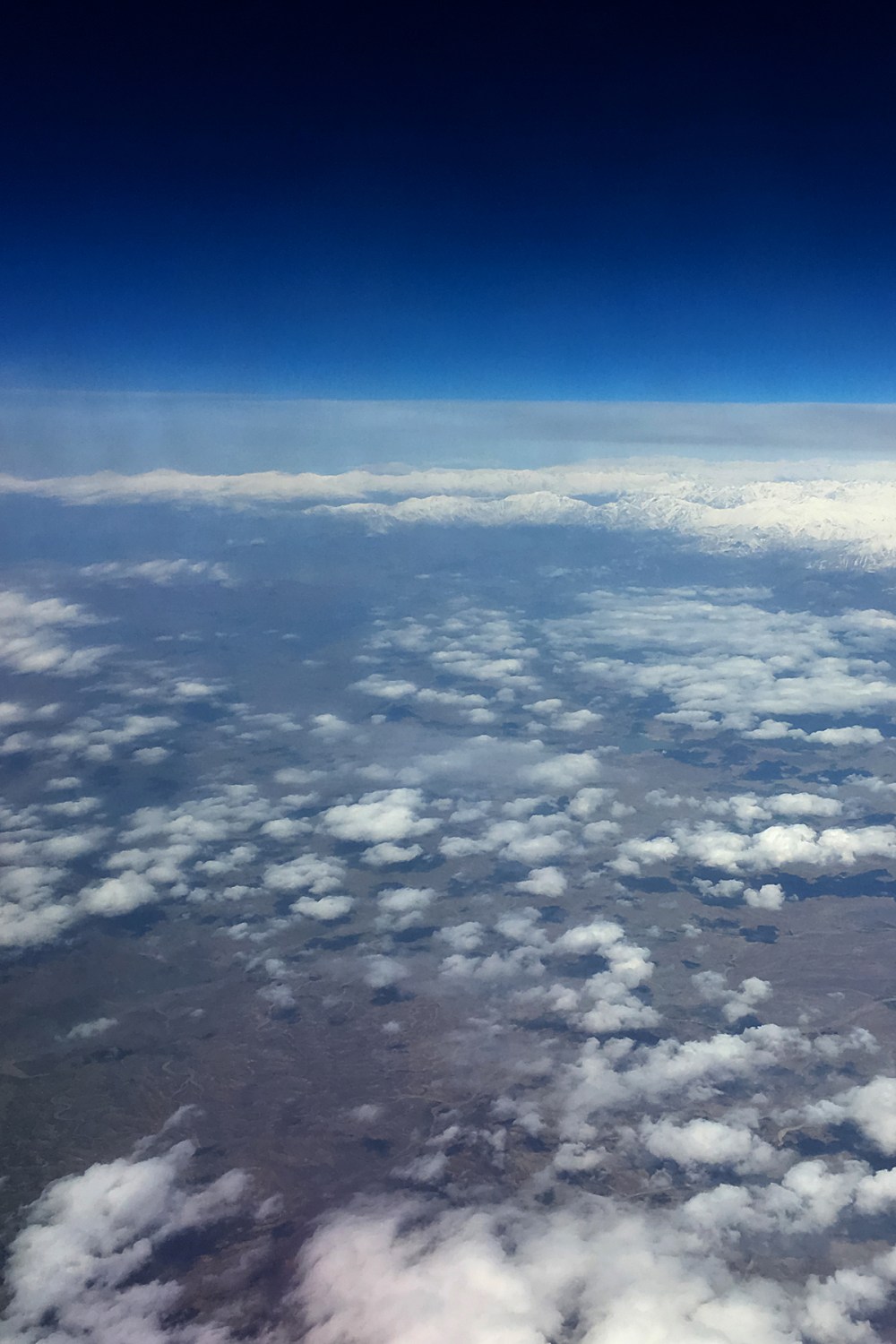
I was a little nervous flying over Afghanistan on the way here (above).  Not because I was worried about flying over Afghanistan, but because of some of the stories I’d read about Uzbekistan.

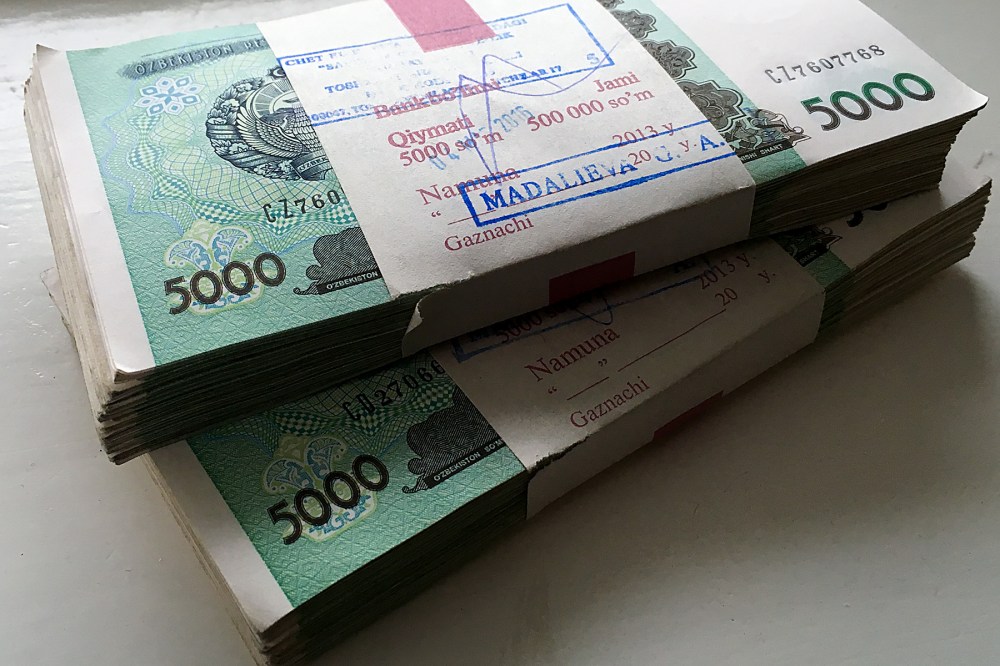
It’s apparently impossible to get hold of dollars here, as the handful of cash machines in the country are always empty.  And I wasn’t sure I’d managed to collect enough in India to get across Uzbekistan.  Customs apparently take your bags apart, searching for prescription drugs, undeclared cash and pornography.  And the currency is apparently so shot that you have to take your money around in carrier bags (due to the fact that the highest note here is only 1000 Soms).

All very dramatic and a bit worrying.  And mostly not quite right (dollar cash machine working, customs polite, bags scanned but unsearched).  Although the currency is definitely shot, and my Uzbek Som are, indeed, in a carrier bag…

IMG_1183 Edit

As it turns out (so far, at least), I feel surprisingly at home here.  Yes, it took a few minutes to get India out of my system.  I got in the wrong side of the taxi at the airport.  I gawped at the cleanliness and quietness of the streets on the way into town.  And I thought I might have gone deaf for a moment, due to the almost total lack of honking.  We even stopped at a pedestrian crossing to allow people to cross.  It was all a bit disorientating.  Disconcerting, even.

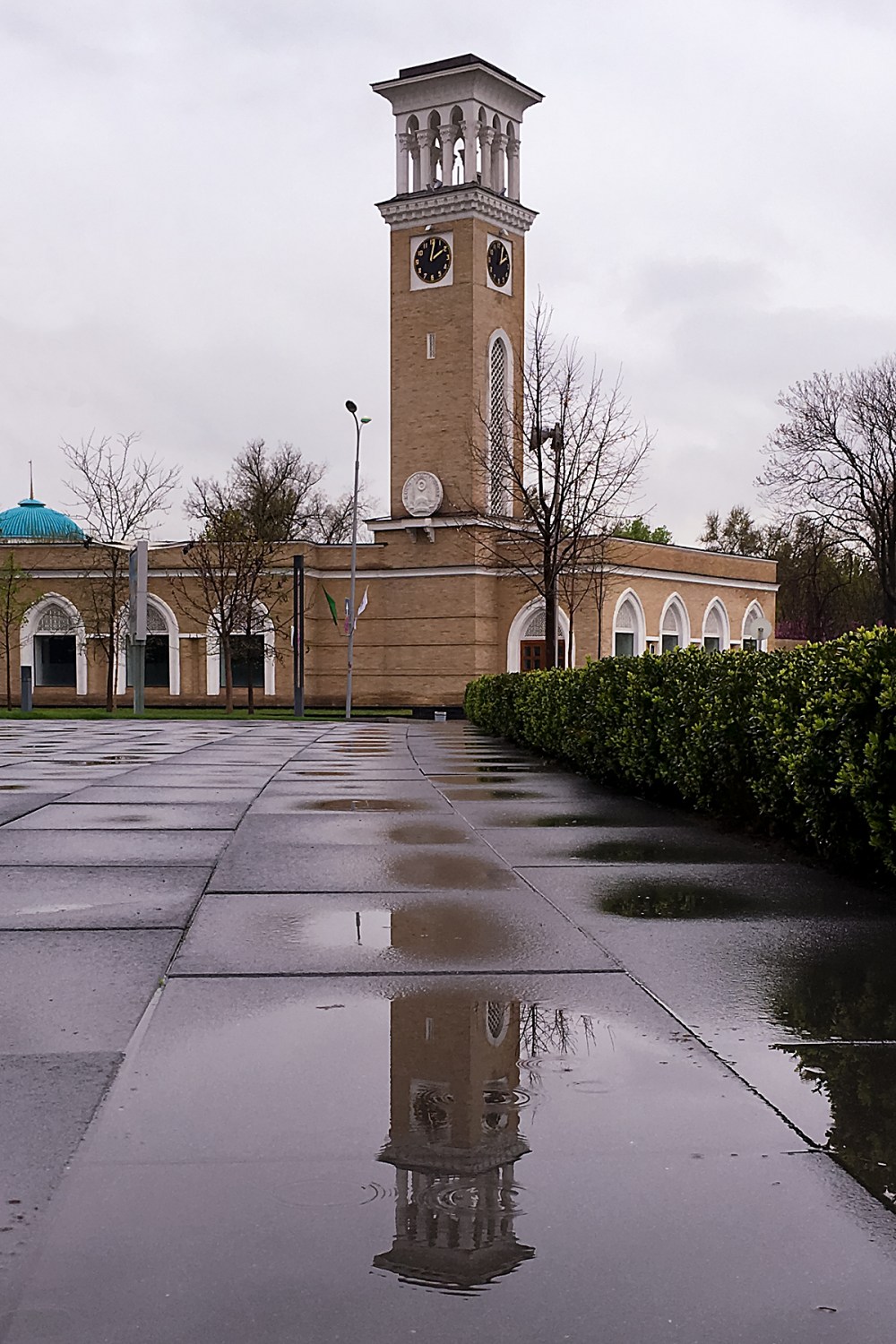
But, fairly shortly after arriving at my magnificently old-school Soviet hotel (above), I realised that I actually knew how things worked here, and that I was probably going to enjoy myself.  Not that the relatively posh hotels will last for long, mind you…

I was lucky enough to spend many months in the former Soviet Union when I was (a lot) younger, as countries crashed, recovered and crashed again in the 1990s and the noughties.  And I speak enough Russian to get by (it’s the common language here).  By the time I’d had my second conversation about unofficial money changing (with the second person I spoke to – it’s a national sport over here), things were starting to come into focus for me.

The currency here is, indeed, something of a mess.  The government sets the official rate (currently just under 2900 Som to the dollar).  The market sets a more realistic rate (currently around 6600).  Although you’re unlikely to get quite the market rate as a foreigner, you can get close with a bit of haggling (another national sport).  You can see both rates here.

IMG_1191 Edit

The dual exchange rate basically halves the cost of anything which is priced in dollars.  Which means that dollar prices initially appear really expensive.  For example, my SIM card and internet package, which was outrageously priced up at $35, actually cost more like $17.  Still very pricey, compared to South East Asia and India, but not too bad.  And, unlike India, it worked as soon as I bought it.

While it’s no longer true that the biggest Uzbek note is 1000 Som (less than 20 cents), things have not changed that much.  The biggest note is now 5000 Som, which is still less than $1 at the ‘real’ rate.  The picture above is a million Som, or less than $200.  And it’s still pretty bulky.

Apart from readjusting to life in the 1990s, I’ve spent my two days in Tashkent generally staring at driving rain.  I managed a couple of little strolls, to inspect the impressive city centre buildings, but the weather has been woeful here since I arrived.

IMG_1187 Edit

I’ve also been enjoying the widespread availability of proper cheese, which is an immense step forward.  And I unpacked and rebuilt the bike today, alleviating the last of the major concerns that were bothering me over Afghanistan.  As always (so far!), the bike survived the flight with no obvious problems, and is ready to hit the road tomorrow (Friday).

And it’s hitting the road in a big way over here.  Most riding days will be over 100 km, as I head south-west for a long, long way, before turning to head north-west to Kazakhstan (for another long, long way).  Ancient cities, camels, and long desert days should be in the offing.

There are likely to be some tough days ahead.  But for now, I’m fed, rested, and raring to go.  The Silk Road is calling, and I’m excited to see what it brings.  As long as the rain stops, I’ll be happy…